

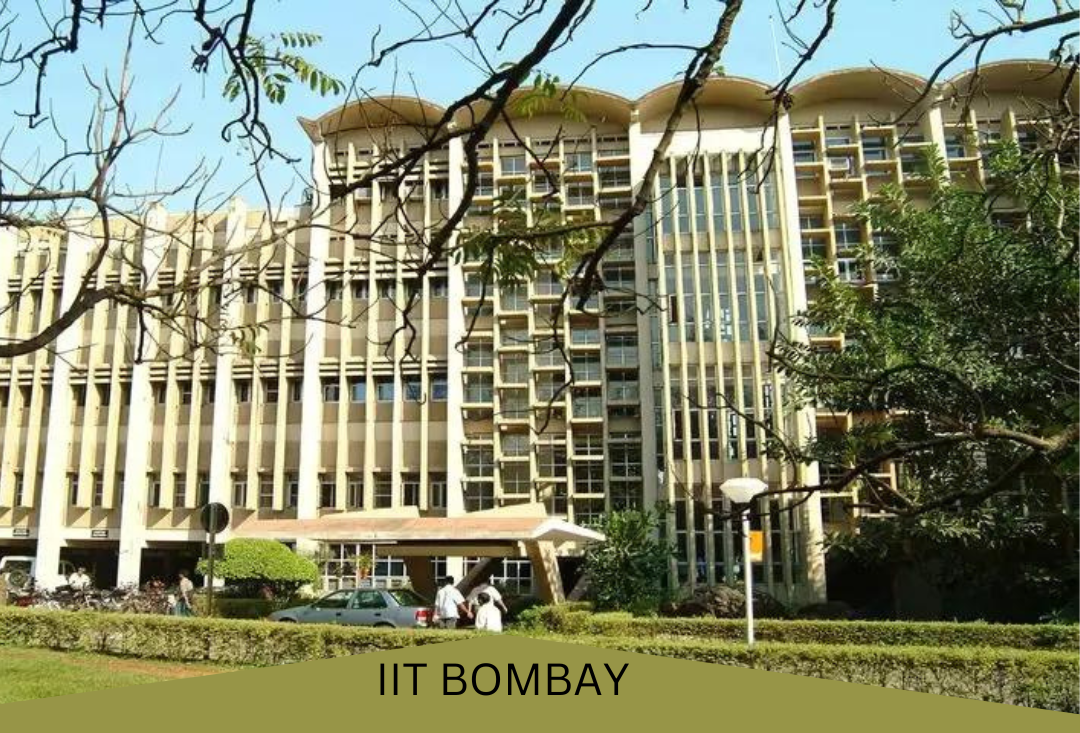

IIT Bombay was the first institute to be founded with foreign assistance in 1958. In 1961 Parliament decreed the IITs as ‘Institutes of National Importance’.The institute is recognized worldwide as a leader in the field of engineering education and research.
As part of its effort to enhance research and enrich its educational programs, IIT Bombay also builds links with peer universities and institutes at the national and international levels.
Located in Powai, Mumbai, Maharashtra, India.
( IITB ) Vision:
To be a leading global technology university that provides a transformative education to create leaders and innovators, and generates new knowledge for society and industry.
( IITB ) Mission:
- To create an ambiance in which new ideas, research, and scholarship flourish, and from which the leaders and
innovators of tomorrow emerge. - To address problems faced by the nation and the world through the talent we nurture and the research we do.
- To provide an education that transforms students through rigorous coursework and by providing an understanding of the needs of society and industry.
- To collaborate with other academic and research institutes around the world to strengthen the education and research ecosystem.
Ranks of the IIT Bombay:
- IIT Bombay ranks 3 in India After the (IIT Madras) and (IIT Delhi).
- If we see the ranks in the world’s best universities then IIT Bombay will rank # 172 as of 2023.
Courses:
The Indian Institute of Technology Bombay (IITB) offers a wide range of undergraduate, postgraduate, and doctoral courses in various fields of engineering, technology, and sciences.
Undergraduate Courses:
B.Tech:
Computer Science and Engineering, Mechanical Engineering, Electrical Engineering, Civil Engineering, Chemical Engineering, Metallurgical Engineering, Material Science, Aerospace Engineering, Mining Engineering, Energy Science, Technology & Policy.
Postgraduate Courses:
M.Tech:
Computer Science and Engineering, Mechanical Engineering, Electrical Engineering, Civil Engineering, Chemical Engineering, Metallurgical Engineering, Material Science, Aerospace Engineering, Mining Engineering, Energy Science, Technology & Policy, Environmental Science and Engineering, Industrial Engineering, Systems and Control Engineering, Technology and Development.
M.Sc:
Chemistry, Physics, Mathematics, and Economics.
Doctoral Courses:
Ph.D:
Computer Science and Engineering, Mechanical Engineering, Electrical Engineering, Civil Engineering, Chemical Engineering, Metallurgical Engineering, Material Science, Aerospace Engineering, Mining Engineering, Energy Science, Technology & Policy, Environmental Science and Engineering, Industrial Engineering, Systems and Control Engineering, Technology and Development, Chemistry, Physics, Mathematics, Economics, Humanities and Social Science.
In addition to the above-mentioned courses, IITB also offers other professional courses such as MBA, MDes, MPhil, and M.Sc in Media and Cultural Studies.
This is not an exhaustive list, It is always recommended to check the official website of IITB for the latest information on courses offered and their specific eligibility criteria, as well as the application process.
Fees:
| BE. / B.Tech | INR 8L – 20L | For 4 To 5 Years |
| M.E./M.Tech | INR 1.2L – 10L | For 2 To 5 Years |
| M.Sc | INR 30K – 2.75L | For 18 months To 6 Years |
| B.Sc | INR 8L | For 4 Years |
| M.Des | INR 82K – 1.2L | For 2 Years |
| MBA/PGDM | INR 4L – 20L | For 2 To 5 Years |
| Ph.D | INR 75K – 3.55L | For 4 To 6 Years |
| M.A | INR 1.2L – 3.55L | For 2 To 6 Years |
| B.Des | INR 9.27L – 11.56L | For 4 To 5 Years |
| Executive MBA/PGDM | INR 42 L | For 18 months |
Cut-offs:
The cut-off for admission to the Indian Institute of Technology Bombay (IITB) varies depending on the program and category of the applicant.
For the B.Tech program, the cut-off is determined based on the candidate’s performance in the Joint Entrance Examination (JEE) Advanced, which is the entrance exam for admission to the Indian Institutes of Technology (IITs).
For the general category, the cut-off for JEE Advanced for IITB has been between 99 to 100 percentile in the past years. For the OBC-NCL category, it has been around 92-93 percentile, and for SC/ST it is much lower at around 70-75 percentile.
For the postgraduate program, the cut-offs are determined based on the score of GATE (Graduate Aptitude Test in Engineering) and mark obtained in the qualifying degree examination.
It is important to note that the cut-off for each program and category can vary from year to year, and it is always best to check the official website of IITB for the latest and most up-to-date information regarding admission cut-offs.
Admission:
The admission process for the Indian Institute of Technology Bombay (IITB) typically starts in the month of April or May, with the release of official notifications and the opening of online application portals.
For undergraduate programs, such as the B.Tech program, the admission process typically begins with the announcement of the results for the Joint Entrance Examination (JEE) Advanced.
For postgraduate programs, such as the M.Tech and M.Sc programs, the admission process typically begins with the announcement of the results for the relevant entrance exams, such as the Graduate Aptitude Test in Engineering (GATE) or the Joint Admission Test for Masters (JAM). Qualified candidates can then apply for admission to IITB through the centralized counseling process conducted by the institute or department.
For doctoral programs, such as the Ph.D. program, the admission process typically begins with the announcement of official notifications and the opening of online application portals. The admission is based on the candidate’s research aptitude, academic record, and performance in an interview.
It is always recommended to check the official website of IITB for the latest information on the exact dates and timelines for the admission process.
0 Comments